It began with a school trying to get rid of its third years.
The fourth, fifth, and sixth years were sitting exams. The building needed to be quiet. So the entire third year was put on coaches and sent north for a fortnight, to a youth hostel in the north of Scotland, to do the sort of things schools arrange when the alternative is having several hundred fifteen-year-olds underfoot.
Two of those days were a survey module.
"They split us into three-man groups, as I remember," Foggo says. "And they had old theodolites, and we had to survey a section of a small loch."
On the second day, the groups joined their work together. "We had to stitch our section of the survey together with the group next to us, and we created a plan of this wee loch. And it was done using the old chains as well."
Consider what that exercise actually contained. Instruments that had to be handled carefully and understood before they would give you anything. A section of real ground, measured rather than estimated. A requirement to coordinate with the group working the adjacent stretch, because your numbers had to meet theirs. And at the end of it, a drawing, a thing that had not existed two days earlier, made by a group of teenagers, describing a piece of the world accurately.
Very little in a school timetable produces an artefact like that.
The question
Foggo came home from the trip with something he couldn't quite name.
"I spoke to my dad and said, what would I have to do as a job to use one of these theodolite things? And my dad said, civil engineers use theodolites."
His dad wasn’t wrong; civil engineers do use theodolites. But the people who use them all day, whose whole discipline is built around measurement and the representation of ground are surveyors, and nobody in that conversation had the word.
Foggo knew it, even then, without being able to say it.
"From third year of school, that was what I wanted," he says. "But in fact, it was the land surveying that had captured my imagination as much as the civil side. It was land surveying."
The long way round
What followed was a career that was consistently interesting but adjacent.
A degree in civil engineering. Five years working as a contractor. Five more in a design office. During the design office years came a secondment to the Forth Road Bridge, where the vertical hangers on the suspension bridge were being retrofitted, the kind of project an engineer might reasonably build a career around.
Then, around 2000, the correction. Foggo moved into land surveying, joining an Edinburgh-based firm where he spent roughly a decade. He helped establish its Glasgow office and ran that office for ten years. In 2010 he went out on his own with 4Site Surveys.
"A leap of faith," he says of that decision, "but it's worked out well, so I can't complain."
Sixteen years on, 4Site Surveys works for architectural practices and for major civils contractors, on measured building surveys and on motorway and bridge projects across Scotland.
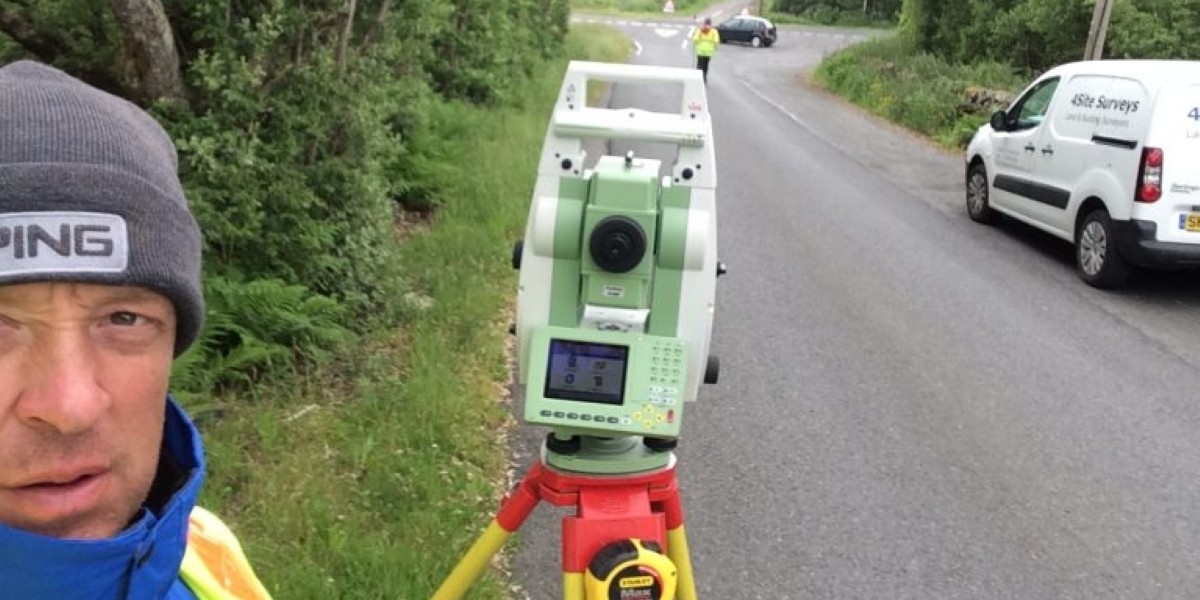
None of the engineering years were wasted. The civils background is part of why contractors trust him on infrastructure work, and he'd be the first to say so. But it took fifteen years to arrive at a destination he had identified, correctly, as a teenager on a school trip. Not because he changed his mind, but because nobody told him the name of the thing.
What kept him
The easy version of this story ends there, with the career found and the circle closed. The more useful question is whether the appeal survived contact with the job − 25 years of early starts, competitive tendering, night possessions, and Scottish weather.
By his own account, it did.
"It's a nice balance of working out on site," Foggo says. "Some of the sites I get to, I see a lot of the country. I was up in Elgin earlier this week." Every site is different, every day is different, and the work turns over quickly rather than grinding on for months. "Every project has its unique set of challenges. So I love the variation."
He does his own processing, the fieldwork and the drawing both, except what he chooses to outsource.
"I've spoken to other surveyors, and they often ask me, do you do the processing of the survey, do you edit the surveys? And I say, yeah. And they look at me enviously, because they're outside every day just doing pure data collection."
"I see the projects through from start to finish," he says, "and I take pride in the survey drawing as it goes out the door. The job satisfaction is pretty high, I have to say."
Which is, in its way, the same thing that happened at the loch. Measure the ground. Produce the drawing. Own the whole of it.
The maths teacher
Some years ago, back at his old school for a meeting, Foggo found himself talking to his former maths teacher and told him where those two days had led.
"He was absolutely delighted to hear that something had come from that."
It's a small moment, and it carries the argument without needing to make it. The teacher had no idea. Why would he? The survey module was two days out of a fortnight, on a trip arranged largely to empty the building during exams. Nobody involved in organising it knew they were starting a career.
They were, though. At least one.
Why it matters
Foggo is close to the best-case scenario. He met the surveying discipline at exactly the right age, in its most engaging possible form, and wanted it immediately and unambiguously. He couldn't name it, and lost 15 years finding his way back. He was lucky, because plenty of people who would love this work never encounter it at all.
That is the gap initiatives such as Get Kids Into Survey exist to close: not persuading young people that surveying is interesting, but ensuring they know it exists, and know what it's called.
Twenty-five years into the career he had to go looking for, Foggo's verdict is brief and worth more than any brochure.
"I've found it to be a rewarding career, and I still enjoy my job today."


.jpg?sc_lang=id-id&hash=9D3078C4386A0CB51FCEA514EF516D5C)


