How Slipcrete built a slipform paving workflow around Leica Geosystems total stations, machine control, and Leica ConX, turning every metre of crash barrier into data the client can be invoiced for the same day.
Author: Peter Haddock
For specialist slipform paving contractor Slipcrete, based in Melbourne, Australia, productivity is measured in metres. The company works across major infrastructure projects for Tier One contractors, and it does one thing: concrete crash barriers on freeways and highways. Owner and director Stuart Kull has 36 years of slipforming experience behind him, and he has built the business around specialist knowledge, highly trained crews, and the integration of Leica Geosystems machine control and surveying technology.
According to Stuart, the difference between a good day and a great day can come down to the final 50 metres of barrier completed. Getting those metres, and being able to prove them, is what the technology on his machines is there to do.
“We only do one thing and we do it very, very well. We do concrete crash barriers on the freeways and on the highway projects with a workflow that keeps everyone happy.”
—Stuart Kull, Owner and director, Slipcrete
The challenge: proving every metre, not just paving it
Slipforming a crash barrier leaves no room to negotiate. The alignment and elevation have to be right as the concrete leaves the mould, because there is no second pass to correct it. Traditionally that certainty came from a specialist surveying team, which meant the paving crew waited on someone else to set out, check, and sign off the work.
The commercial side is just as demanding. A barrier that is built correctly still has to be measured, recorded, and claimed before the contractor sees the money. Where that record depends on a separate survey visit, the claim waits, and so does the cash.
Slipcrete set out to solve both problems with the same workflow: put accurate positioning in the hands of the concreters running the machine, and capture the as-built record as a by-product of paving rather than as a separate job.
The solution: four total stations and a live position
On site, Slipcrete combines multiple Leica Geosystems total stations with machine control to guide its slipform pavers. The result is a continuous stream of positioning information that allows the paving operation to hold the required alignment and elevation, and to record what it has built as it goes.
- Client survey teams create the paving files and upload them directly into the job set up on Leica ConX.
- The files reach the machine over its own SIM card and the 5G network, so no one carries data to site.
- Three total stations are positioned to track machine control prisms, giving the machine its orientation and elevation.
- A fourth total station monitors a quality assurance prism mounted on the rear of the mould, checking the barrier as it is formed.
- The crew leapfrogs the total stations ahead of the paver, so the machine keeps moving while positioning stays accurate.
- The foreman's tablet mirrors the machine-mounted tablet, and the office follows the same job in Leica ConX.
- At the end of the shift, reports go up from the tablets using the control measurements, ready for the office to claim against.
“What we see on the foreman’s tablet is exactly the same as what we're seeing on the machine control mounted tablet. And we can also monitor progress through the Leica ConX platform as well.”
— Stuart Kull, Owner and director, Slipcrete
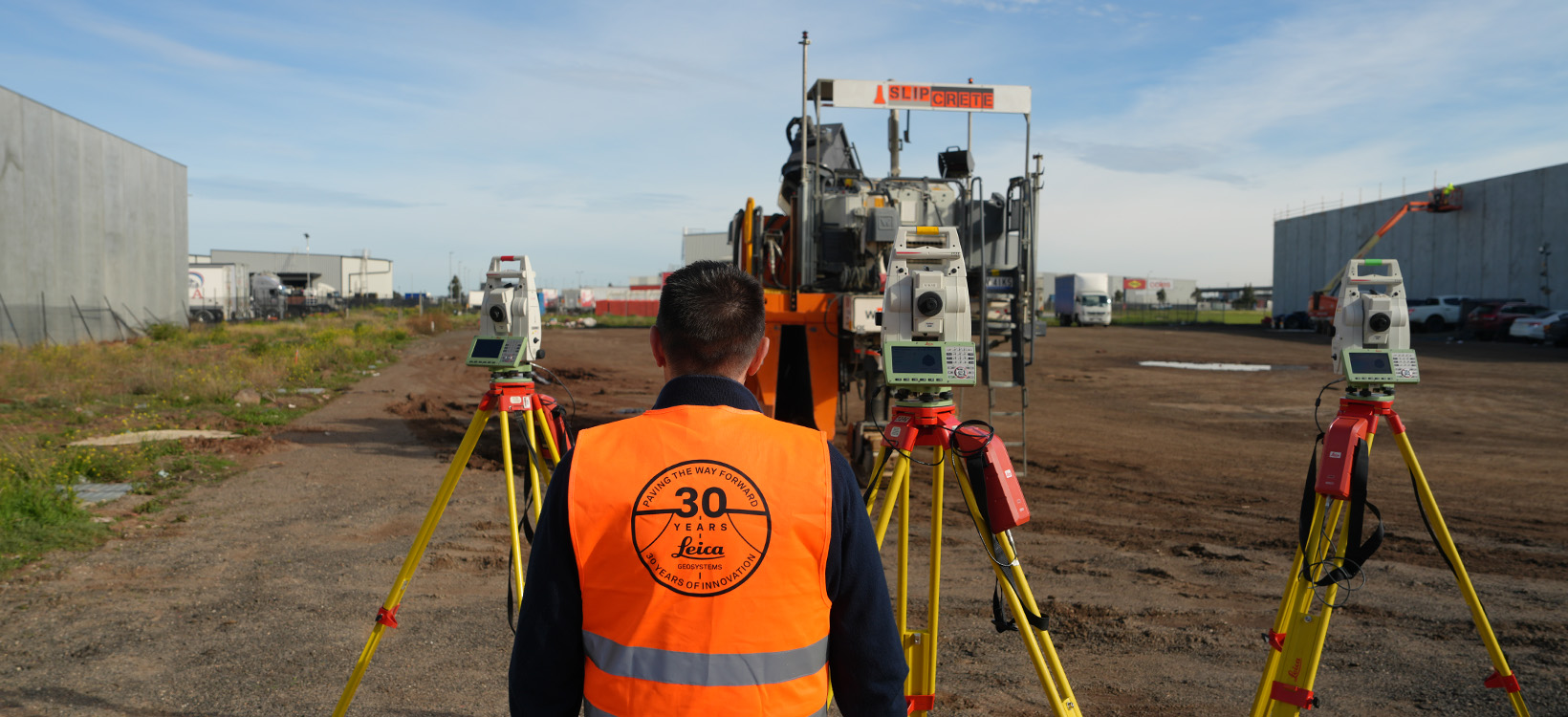
In the hands of concreters, an hour before the concrete
Slipcrete's crews are not traditional surveyors. They are concreters and finishers who have been trained to use the Leica Geosystems equipment, which makes the technology part of the everyday paving operation rather than the preserve of a specialist surveying team. The company worked with its Leica Geosystems dealer, C.R. Kennedy, to get them there.
“We looked at how we could be more efficient onsite and worked with our Leica Geosystems dealer C.R. Kennedy to train up our crew members so they could set out, monitor and manage a job. This has saved us so much time and the levels of accuracy we are achieving are great.”
— Stuart Kull, Owner and director, Slipcrete
That ease of use matters most in the early morning set-up. The survey team arrives around an hour before concrete, with the equipment online and ready before the paving operation begins. Nothing about the start of the day depends on a specialist being available.
“The beauty of the Leica Geosystems total station and machine control system is that it's easy for a novice to use.”
— Stuart Kull, Owner and director, Slipcrete
The same pattern scales. With multiple crews working across different projects, each machine runs its own Leica Geosystems total stations and machine control set-up while the data is captured and shared centrally, so the office sees every job in one place.
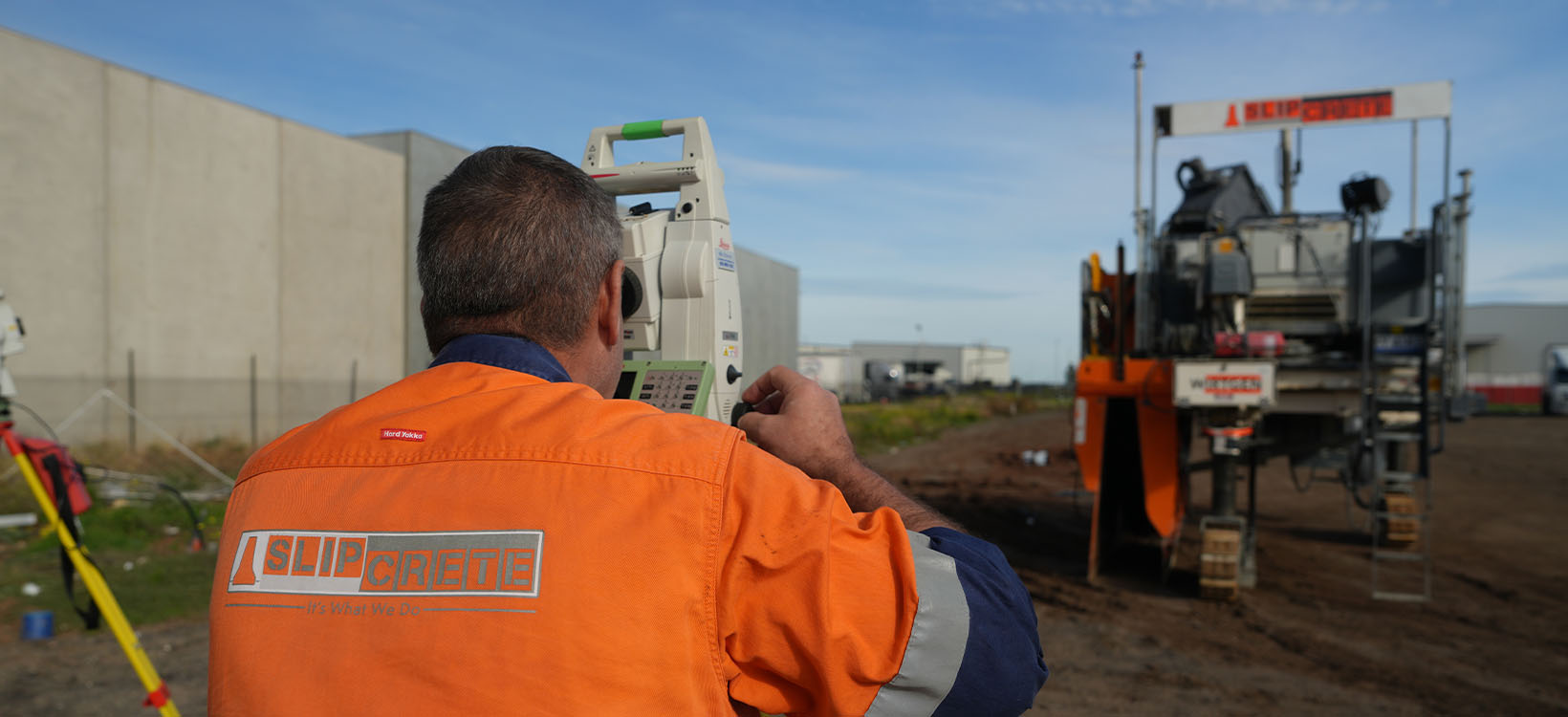
Every metre matters
For Slipcrete, the value of machine control is not simply accuracy. It is productivity. Because the total stations move ahead of the paver rather than the paver waiting on the total stations, the machine keeps running, and a smoother process turns directly into metres on the ground.
“When you have a smooth process you drive efficiency and for our projects the more you can do in the day the more profitable you can be. For example, that extra 50 metres that we get at the end of every day is money for jam. It's how the technology helps us to make our money every day.”
— Stuart Kull, Owner and director, Slipcrete
Stuart also values how cleanly the positioning system sits on the machine itself. Having spent time working in Switzerland and Europe, he was already familiar with the integration between his Wirtgen slipform paving equipment and Leica Geosystems.
“The integration between the two is seamless. It really is the BMW of the world.”
— Stuart Kull, Owner and director, Slipcrete
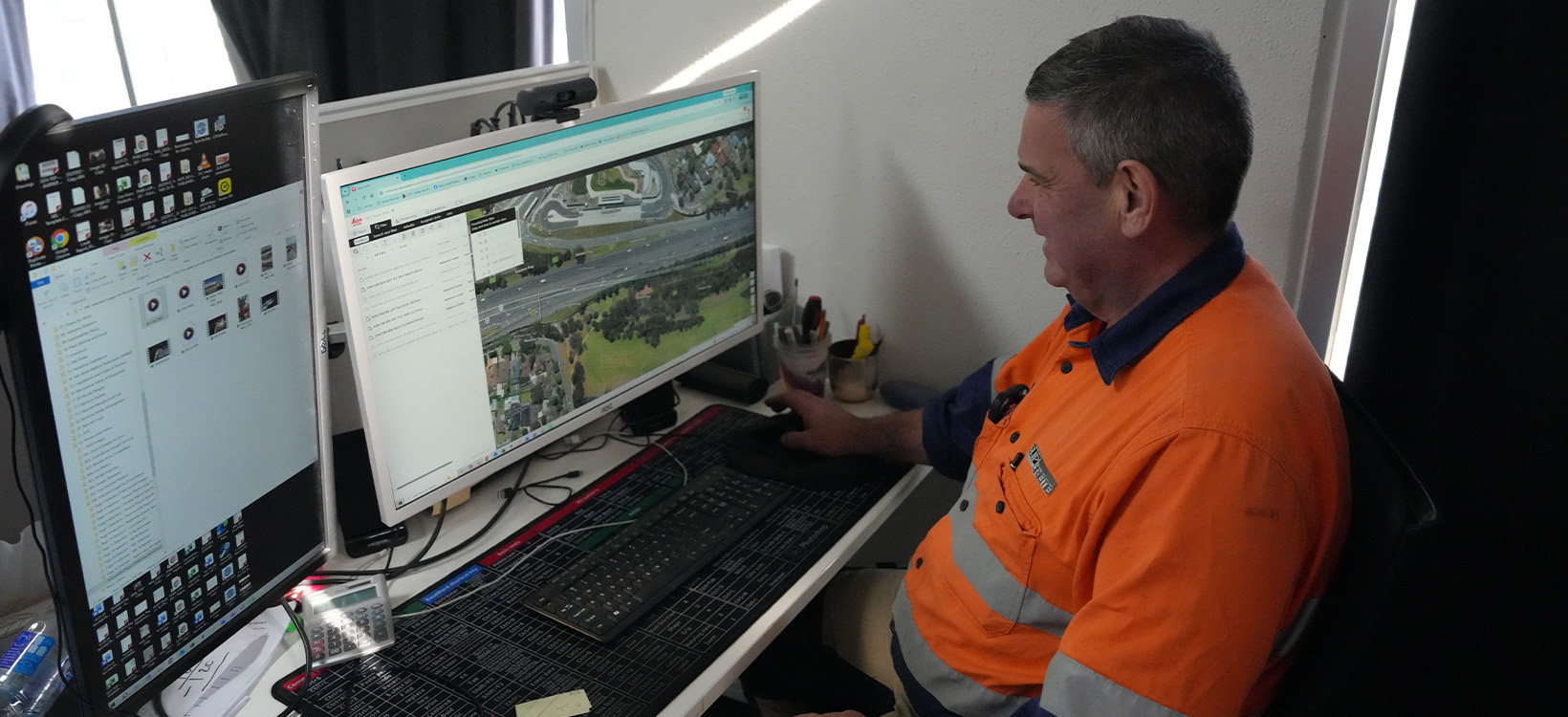
When the data does the talking
Leica ConX sits at the centre of the workflow, connecting Slipcrete's field teams with client surveyors, engineers, and the company's office operation. Slipcrete maintains active, future, and archived data folders, so files stay accessible throughout the project and afterwards.
“We share access to the Leica ConX cloud platform with our clients. They create our paving files for us and they upload the files directly into the job we have setup on the Leica ConX platform. It's our central hub and the brains of everything we do.”
— Stuart Kull, Owner and director, Slipcrete
Because the record is built as the barrier is, Slipcrete can answer from the office what used to need a return visit to site:
- How many metres of barrier were completed on any given shift?
- Exactly how long and how high is the barrier that has been built?
- Which files was the machine working to, and when were they issued?
- Where is each crew, on which job, right now?
“We know exactly to the millimetre how long our barriers are and how high our barriers are.”
— Stuart Kull, Owner and director, Slipcrete
That record feeds the commercial process directly. At the end of each shift, reports are uploaded from the tablets using data from the control measurements, and the office team processes the information and raises the claim.
“Everything every day is captured, invoiced, and straight off to the client for a claim every day.”
— Stuart Kull, Owner and director, Slipcrete

The bottom line: accuracy that gets paid
For a contractor in the same position, Slipcrete's workflow shows what the investment actually buys:
- Positioning accurate enough to slipform a barrier right the first time, with a fourth total station checking the work as it leaves the mould.
- Concreters and finishers who can set out, monitor, and manage a job themselves, so paving never waits on a surveyor.
- An extra 50 metres at the end of the day, every day, on a machine that keeps moving.
- An as-built record precise to the millimetre, captured while paving and turned into a same-day claim.
“The data doesn't lie. It's perfect and our invoices are paid.”
— Stuart Kull, Owner and director, Slipcrete
By combining specialist slipforming expertise with Leica Geosystems positioning, machine control, cloud connectivity, and digital reporting, Slipcrete has built a workflow where accuracy, productivity, and commercial certainty work together. For a business where every additional metre counts, that could be the most valuable measurement of all.
Discover Leica Geosystems' concrete paving solution here.


